



The modern age has brought us into a new reality where social networks and media create and promote narratives and information that undermine the legitimacy of not only Montenegrin but also societies around the world.
The current situation regarding the Law on Freedom of Religion has deepened the crisis in relations between the Serbian Orthodox Church and the Montenegrin state. This has resulted in an intense disinformation campaign, and consequently a lack of trust in the media, with the crucial question being – who to trust?
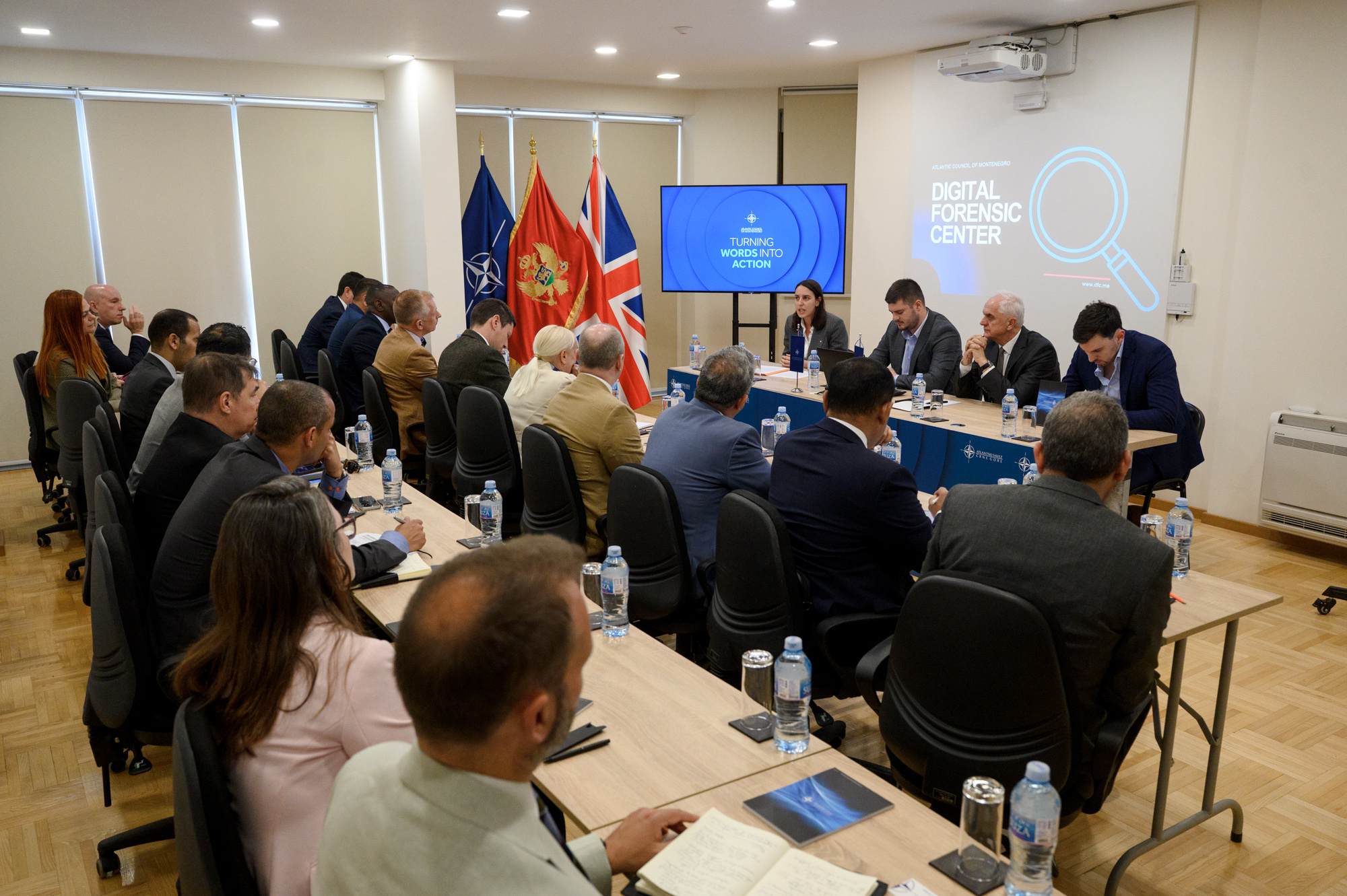
In such conditions, working with young people, high school pupils and students is crucial in the fight against disinformation. Therefore, Digital Forensic Center of the ACM organized a two-day workshop for young people who were interested in training. The aim was to teach participants more about the pervasive phenomenon of disinformation – how to combat this phenomenon, what psychological aspects are behind the disinformation campaigns, what is the modus operandi of campaigns seen across Europe and the world etc.
Lecturers Darko Brkan from Raskrinkavanje and Milan Jovanovic from DFC, after providing participants of this two-day training with theoretical knowledge, demonstrated practical exercises. The participants were educated on how to find information in order to check the accuracy of texts through open-source tools, how to determine geolocation, and finally how to write text. After that, the students did specific exercises on their own.
Participants were also instructed how to make a good lie by taking information that is not easy to verify. Media types (public and private agencies, public, commercial and online media, social networks) were highlighted. Phenomena of bots and trolls, misinterpretations of terms, and distinctions among them were also discussed.
Also, concrete examples were presented on how the creation of disinformation can be grounded in political interests, and often in money.
Conclusions and recommendations:
- Emerging forms of media manipulation are: fake news, spreading fake news, spin, disinformation, fact manipulation, pseudoscience, conspiracy theory, biased reporting, censorship.
- In the domain of credibility, professional media must have a published impressum, contact, data, as well as ownership and publisher information, form, content and must be transparent.
- Participants showed a high level of media literacy, answering correctly to over 83% answers of the given quiz.
- Participants demonstrated the ability to put theory into practice through a series of successfully completed exercises in various fields.
- According to the participants, the approach of focusing on the practical and interactive part, along with teamwork, is what really raised the workshop to a higher level.
- A long-term process of raising awareness in the field of media literacy among the youngest, as well as strengthening digital literacy, as a resistance to disinformation is needed in Montenegro.
- It is agreed that the subject Media Literacy should be an integral and obligatory part of the secondary school curriculum.
- The participants expressed their interest in further workshops on various topics, such as the impact on the media when writing and publishing text, the detailed presentation of open-source tools, or a workshop that would address security and safety on the Internet.